Ya know, for a site called “CSS-Tricks” that I’ve run for well over a decade, it’s a little funny we’ve never done a book under that name. I’ve written a book about WordPress and SVG, but never CSS!
Well, allow me to change that. I’ve been working on a “book” called The Greatest CSS Tricks Vol. I, as my attempt to stay true to this site’s name! The big idea to make it like a coffee-table book for CSS, where each chapter is totally independent and talks about one literal CSS trick that I’ve found to be exceptionally clever and useful. A book about quite literally the best CSS tricks I’ve come across over the years.
I quoted the word “book” above because this is the loosest possible definition of a book. I have not yet made it into an eBook format. I have not even considered printing it yet (although there is a “full book” URL available with the whole book together for printing and print-to-PDFing). This book exists as URLs which are essentially fancy blog posts grouped together. I’m also calling it Volume I as there are already ideas for another one!
Some chapters are fairly broadly known concepts that I’m writing up to put a point on. But many of the chapters are based on ideas that can be traced back to individual people and I always try to credit them directly.
I say so far because I might add a few and rearrange them and such, not to mention it could still use a healthy bit of editing. But I think the bulk of the value of the book is already there.
Value? I think so. While it’s fun to learn some CSS trickery, I think there is value beyond the tricks themselves. Tricks help you see how CSS works at a deeper level. When you understand the trick, you’re seeing how that part of CSS works through a new lens and it helps you be more in tune with the nature of that CSS. It will help you reach for those CSS properties more intuitively when you know what they are capable of.
In another sense, it’s like taking a walk with weights in your backpack. You do it on purpose so that when you walk normally, it feels easier. The tricks are like mental weights. They make writing non-tricky CSS feel easier.
So about buying the book. You don’t buy the book directly. What you buy is an MVP Supporter membership to this site. When you’re an MVP Supporter, you have access to the book, and more. This is the whole package:
No Ads. You see no ads on this site, except for sponsored posts which are just blog posts and I try to make useful anyway.
Extra Content. You can read the digital books I’m making (you can already read some chapters, but they are under progress.)
Easier Commenting. You’ll be logged in, so leaving comments is easier and won’t require the delay for approval.
Good feels. An extreme sense of satisfaction of supporting this site and our commitment to bringing you useful tech knowledge.
It’s just just $20/year.
Have I, or this site, helped you out over the years? This is the best way to say thanks.
Also, if you would really like to have access to read the book, and can’t afford it right now, I totally get it. Email me at chriscoyier@gmail.com and we can work that out.
Fractl has produced thousands of content marketing campaigns across every topic, and for the past seven years, we’ve been keeping track of each and every campaign in order to refine and improve the content we produce on behalf of our clients.
In my last post for Moz, I explained how to set realistic digital PR expectations for your content based on your niche. In this topic, I want to dive a little bit deeper into the data and share insights about how the source of your content can be just as important in determining how your content will perform.
In this analysis, I looked at 1,474 client content campaigns across six different data source categories:
Client data
Social media
Participatory methods
Publicly available data
Survey
Germ swab
It’s important to note that there are countless other data sources that we use for content campaigns every day at Fractl that are not mentioned in this article. In this analysis, each category has at least 20 campaigns, while some categories have several hundred campaigns.
It’s also important to note that averages were collected by excluding upper outliers. For campaigns that went “viral” and performed well above the norm, we excluded them in the calculation so as not to skew the averages higher.
In addition to sharing link and press averages, I will also be walking through how to produce pressworthy, sharable content from each data source and providing examples.
Managing expectations across content types
Across the entire sample of 1,474 campaigns, a project on average received 24 dofollow links and 89 press mentions in total.
A press mention is defined as any time the content campaign was mentioned on a publisher’s website.
There were some individual data source category averages that were on par with the sample average, while other categories deviated greatly from the sample average.
Publicly available data
For almost any niche out there, you can bet there is a publicly available data set available for use. Some examples include data from the CDC, the U.S. Census, colleges and universities, the WHO, and the TSA. The opportunities really are endless when it comes to using publicly available data as a methodology for your content.
While free data sets can be a treasure trove of information for your content, keep in mind that they’re not always the simplest to work with. They do require a lot of analysis to make sense of the massive amount of information in them, and to make the insights digestible for your audience.
Take for example a campaign we produced for a client called Neighborhood Names. The data was free from the US Census, but in order to make any sense of it, our researchers had to use QGIS, Python, text-mining, and phrasemachine (a text analysis API) just to narrow it down to what we were looking for.
And what were we looking for? Looking at neighborhood names across America seems boring at first, until you realize that certain words correspond to wealth.
I was the outreach specialist for this project, and by using the wealth angle, I was able to secure two notable placements on CNBC as well as a press mention on MSN. The project quickly made its way around the internet after that, earning 76 dofollow links and 202 total press mentions by the end of our reporting period.
Survey
Unlike scouring the internet for free data, using a survey as a methodology can be more costly. That being said, there is one major advantage to using a survey to shape your content: you can find out anything you want.
While publicly available data will tell a story, it’s not always the story you want to tell, and that’s where surveys come in.
Of course, when it comes to surveys, anyone can create one without paying attention to research method best practices. That's one of the problems we need to address. With “fake news” in the forefront of everyone’s minds in 2020, building trust with journalists and editors is of the utmost importance.
As content creators, we have a responsibility to ensure that content is not only attention-grabbing and entertaining, but also accurate and informative.
Survey campaigns, in particular, require you to analyze responses through a rigorous methodological lens. When collecting data for surveys, be sure to pay close attention to ethical upholdance, data validity, and fair visual representations.
Germ swab
From my own personal experience, germ swab content campaigns are the most fun, and often, the most disturbing. Fractl did some research a while back about the emotions that make content go viral, and oftentimes, germ swab campaigns hit all of the right emotions in the viral equation.
Negative emotions like disgust are often evoked when reviewing the results of germ swab campaigns. Our study found that when negative emotions are paired with emotions like anticipation or surprise, they can still achieve viral success (internet viral, not germ viral). What is more surprising than finding out the airplane tray table is dirtier than a toilet seat?
Publishers around the world seemed to think the content was surprising, too. This campaign performed above the norm for a typical content campaign earning 38 dofollows and 195 total press mentions — and this was before the COVID-19 pandemic.
Participatory methods
Participatory methods are campaigns that require active participation for the methodology. These are unique ideas — no two are alike. Some examples of campaigns that fall under the participatory methods category are when we had team members do a 30-day squat challenge, asked respondents to draw brand logos from memory, or when we literally drove from D.C. to NYC with a dash cam to record traffic violations.
These campaigns have a certain level of risk associated with them. They require a lot of upfront effort and planning without the promise of any return — and that’s scary for clients and for our team who put in tremendous effort to pull them off.
As you can see from the chart above, however, these ideas collectively performed right on par with other campaign types, and even better than survey methodologies for both the number of dofollow links and press mentions. In order to reap big benefits, it seems you need to be willing to take a big risk.
Social media
Social medIa as a data source is almost a no-brainer, right up there with survey methodologies and publicly available data sets. Unlike participatory methods campaigns, you don’t have to leave your computer in order to produce a campaign based on social media data.
Through our seven years of content creation, Fractl has produced campaigns based on data scrapes from Twitter, Instagram, Facebook, LinkedIn, Reddit, and more. From this experience, we know firsthand what kinds of social campaigns work and which ones fall flat.
The best thing about using social media as a source for content is that it can be applied to all verticals.
The biggest lesson we’ve learned from producing content based on social media data is that the methodology is typically subjective, so you need to keep the project lighthearted in nature in order to earn major coverage.
For example, we produced a campaign for a client in which we looked at Instagram posts with the hashtag #sexy and a geolocation. From this, we were able to glean the “sexiest” countries in the world as well as U.S. states.
While it would be impossible to learn what the actual sexiest places in the world were, (what does that even mean?) we were able to produce a fun campaign that used geo-bait to appeal to lighthearted publishers, like Glamour, E! Online, Women's Health, and Elite Daily.
Make sure that no matter the topic, whatever you produce contributes to an ongoing conversation. Statistics that don’t point to anything meaningful won’t be relevant for writers actually trying to add to the conversation.
Client data
Client data is often the most underappreciated data source for content marketers. You may be sitting on a wealth of actionable industry insights and not even know it.
You might think of internal data as only being useful for improving your internal processes at work, but it can also be valuable outside of your organization.
Unlike publicly available data, internal data is never-before-seen and 100% unique. Journalists eat this up because it means that you’re providing completely exclusive resources.
Think of this article, for example. This article is filled with data and insights that Fractl has gleaned after producing thousands of content marketing campaigns.
An added bonus of using internal data to craft your content is that, according to our analysis, it performs on par with surveys. Unlike surveys, though, it’s completely free.
Conclusion
No matter what methodology you’re using or vertical you’re creating content for, it’s important to realize that as content creators, we have an ethical and moral responsibility to create with an audience in mind.
With “fake news” on the forefront of everyone’s minds, building and maintaining trust with writers and editors is of the utmost importance.
All of the content you produce and promote must be assessed through a rigorous methodological lens to ensure that content is accurate and informative as well as eye-grabbing and entertaining.
Regardless of your methodology, if you don’t take the proper steps to make sure your data sources are accurate, you are contributing to the fake news epidemic.
Sign up for The Moz Top 10, a semimonthly mailer updating you on the top ten hottest pieces of SEO news, tips, and rad links uncovered by the Moz team. Think of it as your exclusive digest of stuff you don't have time to hunt down but want to read!
from The Moz Blog https://ift.tt/2BLLSab
via IFTTT
Sarah Higley has some CSS tricks up her sleeve for dealing with High Contrast Mode on Windows, which I learned is referred to as WHCM.
Here’s the first trick:
[…] if the default CSS outline property doesn’t give you the visual effect you want [in WHCM] for focus states, there’s a very simple fix. Instead of overriding default browser focus styles with outline: none, make it transparent instead: outline 3px solid transparent.
That will essentially do nothing outside of WHCM, but in WHCM, it will be a thick white border, which is a strong, good visual focus style.
One of my forever-lessons here on CSS-Tricks is that having your own website and blogging on it is a good idea. It’s probably one of the best decisions I’ve ever made, as it’s been a direct source of fun, career development and, eventually, income.
I always chuckle at little blogging is coolagain declarations from the community. It’s always cool, my friends. But it is always nice to see more people pick it back up.
I enjoyed this post from Max Böck that gets into how what is old is new again. Server side rendering! Personal websites! Blogging! Heck yes.
The other day, I was doom-scrolling Twitter and saw a delightful article titled “The Case for Fussy Breakfasts.” I love food — especially breakfast — and since the pandemic hit I’ve been using my breaks in between meetings (or, shh, sometimes in meetings) to make a full bacon, poached egg, vegetable plate. Suffice to say, I really got into the article. This small joy of creating a bit of space for myself for the most important meal of the day has been meaningful to me — while everything else feels out of control, indulging in some ceremony has done a tiny part to offset the intensity of our collective situation.
It caused me to think of this “fussiness” as applied to other inconsequential joys. A walk. A bath. What about programming?
While we’re all laser-focused on shipping the newest feature with the hottest software and the best Lighthouse scores, I’ve been missing some joy on the web. For example, I’ve come across apps that seem to convey little care for UX, guidance, richness, and… well, let’s just say that for humans trying to communicate through a computer, we’re certainly bending a lot to… the computer.
Which is a good reminder for us all: the web is more than a mere document reader. While I do love me a healthy Lighthouse score, some of these point matrixes seem to be driven more by our own developer ego in some form of gamification race to the creative bottom rather than a challenge or opportunity. It’s like a hyper-focused attention to shedding bytes and server requests is coming at the expense of creative ways to accomplish delightful experiences. It’s still possible to dazzle users with a solid combination of content, color, and layout if we’re willing to be a bit adventurous — with little to no additional weight at all!
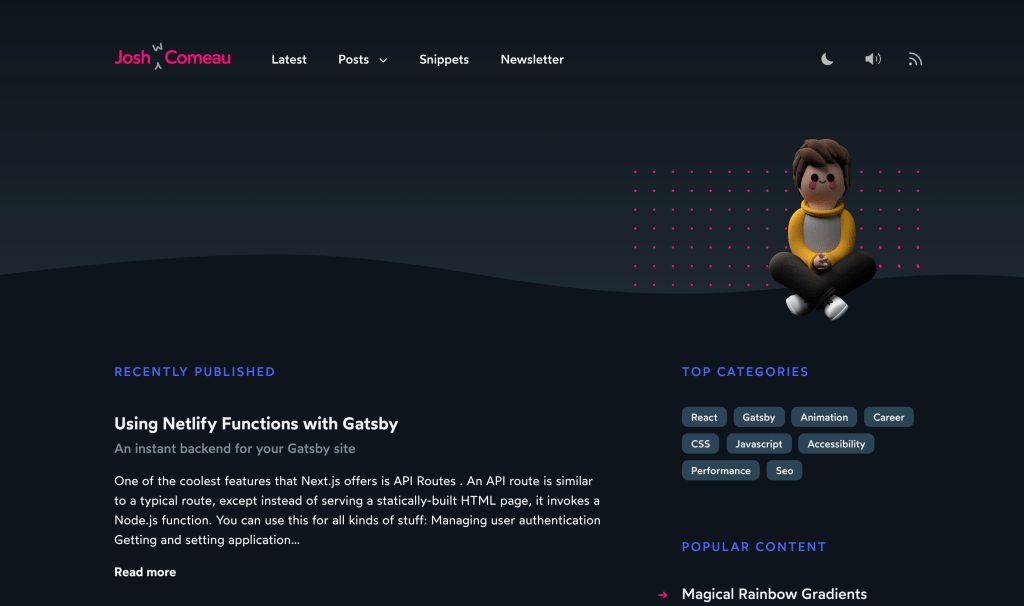
A few of my favorite personal developer sites these days are from Josh Comeau, Johnson Ogwuru and Cassie Evans. The small touches and careful attention to detail lead to these little a-ha! moments that make me want to stick around for a while. I wander around the site, exploring, learning, and feeling more connected to each of these talented devs as people. And notice how they pull it off without laggy performance. They flex their creative and technical muscles and put pure pride into their work and it intrigues me!
Just Corneau uses clever illustration and layout combinations that make his site fun to look at — not to mention great content we can all learn from.
It’s easy to get stuck in absolutes and one absolute to watch out for is the belief that anything fun or featuring a flair of style mean it’s “not useful.” I’d argue that the opposite is true. Emotions attach to the limbic system, making memories easier to recall. If your site is a flat bit of text, how will anyone remember it?
Don’t you want to build the site that teams in companies the world over remember and cite as an inspiration? I’ve been at four different companies where people have held up Stripe’s site as an aspirational example. Stripe took chances. Stripe told stories. Stripe engaged the imagination of developer and spoke directly to us.
It honestly makes me a little sad to acknowledge the irony of using a site as an example of what to do then tossing out the things that make it great for other priorities. Any creativity, risk, and intention that goes into great experiences like this gets slowly, piece by piece, chipped away by the drumbeat of “usefulness.” It’s like missing the forest for the trees.
It’s clearly apparent when a site is done with care and excitement. You feel it as you visit, that hum of intention. These are the sites with low bounce rates and the best engagement metrics. They’re the ones that elicit questions like “How can I contribute?” No gimmicks necessary.
Sure, there are lots of factors at play. I get it. Every person or company has constraints and competing priorities. Of course, we all have to get things over the line.
Perhaps a challenge: What small thing can you incorporate into a project that adds a dash of delight to the user experience? Can you start with a something like a hover effect on a link or button? Hey, I didn’t start my new breakfast regimen with a perfectly poached egg; I started by making a goofy scrambled one and I improved on it from there. We can all do the same when it comes to finding opportunities to create engaging websites. Can you outsource one graphic? Can you introduce a tiny easter egg? Perhaps you can write something with a little more personality than the typical corporate lingo.
If something is meaningful to you, the audience you gather will likely be the folks that find it meaningful too.
This kind of SVG + CSS animation trickery is catnip to me. Mikael Ainalem shares how to draw a hamburger icon (the “three lines” thing you’re well familiar with), but then animate it in a way that is surprising and fun by controlling the SVG properties in CSS.
The trick is that the top and bottom lines aren’t just a straight <line /> but a <path /> that curves up, down, and around forming the cross. You can only see part of the line (making it appear straight at first) because the stroke-dasharray only reveals part of the line. Then, by animating both the stroke-dasharray and stroke-dashoffset, the ✕ is formed.
Link building is never-ending in SEO, but a little creativity and smart tactics can help you ferret out great link opportunities from their hiding spots. In this episode of Whiteboard Friday, Britney Muller kicks off a series on modern link building (including the sage advice: let people choose their own anchor text!)
Click on the whiteboard image above to open a high resolution version in a new tab!
Video Transcription
Hey, Moz fans. Welcome to another edition of Whiteboard Friday. Today we are going to be looking at the easiest ways for you to get backlinks to your website. None of these involve content creation whatsoever.
Really excited to dive into this. It will be part of a larger "Link Building in 2020 Series and Beyond." So really excited to dive into some of the easiest things that you can do today to enhance your backlink profile. Let's take a look.
No-brainer link building
☑ Unlinked brand, product, name, etc. mentions
This is simply just going to Google, doing a search for these things within quotes, and looking at the first several pages of results to ensure that all of those results are linking back to your site.
They likely are not, so those will be your opportunities to send a message or an email asking for the webmaster or the writer to provide a link back to your site with your mention. It's one of the easiest things to do. So is unlinked images.
☑ Unlinked images
This is a gold mine if you're working with a website that has a lot of proprietary images or really great graphic design, maybe you have infographics or some things that are special to the brand or the domain. Use Google reverse image search and put in the images that you think might have been taken or used on other websites.
You will immediately see what those websites are and whether or not they link back to your site. So again, very similar to this first one. You're basically just asking for them to credit the website and link back accordingly.
☑ Redirect your 404 pages with backlinks
This is completely within your control. No outreach required. In fact, Moz Link Explorer provides this really, really easily within Moz Pro. You basically take a look at all of your pages that have backlinks, and you can filter by status code.
You just change that to 400s, 404s, and you can see all of the pages to your website that currently have backlinks but the page is no longer there. All you want to do with that is just simply 301 redirect that old broken page to a new relevant page, and you're kind of saving that authority that is being sent to your site.
So, so easy. A lot of people forget about that one. It's great.
☑ Keep an eye on recently lost links
The keyword here is "recently." If you can engage with another website that has recently either by accident or changed things around on purpose on the page, you are more likely to reclaim your lost link.
It's also just important to really understand why.
Is that website going through a redesign?
Have they gotten rid of pages?
Did a competitor come in and provide a better resource than what you currently had?
There are all sorts of reasons why you really want to identify what's going on.
☑ Move backlink targets
This is a new tactic that was recently brought to my attention by the brilliant Sarah Hollenbeck at Siege Media. They have a brilliant team. I highly recommend you checking out this article that's basically all about moving backlink targets, which has never really occurred to me, where you basically have backlinks to older resources or older content or products that you want restructured to newer or more important pages on your website.
Sarah goes into great detail about this and can help explain just how you can do this successfully and what that means for your site. So really, really neat. I highly suggest that.
☑ Sites that list competitors, but not you
Check out sites that list competitors but not you. These might be resource pages or roundups of information of sorts.
You can play around with this in Google as well by providing competitors within quotes and then minus your company or the website you're working on.
It really starts to give you an idea of what websites might be great opportunities for a backlink, because you fit within that vein. It makes sense.
☑ Sites that provide topic/industry + geo information
Similarly sites that provide topic or industry plus geo information, so again finding those resource pages, those roundups. Oftentimes you will see these on lots of .edu sites or even .gov. So you can do some different searches around, if you were Columbia, outdoor clothing in Minnesota.
Play around with this a bit. This could be in the Midwest, in the United States. You can change these words around and really start to identify some higher-quality link prospects.
☑ Build relationships
Lastly, build relationships. I cannot speak more highly about this.
Just for your own career longevity and what you do in SEO and marketing in general, it is so important to develop genuine, real relationships with individuals that work in the industry, whether that be at other websites or just in the same vein of things.
Not only can you bounce ideas off of these people and really get help with different things, but you get to help support the incredible things that they're working on. It's just an all-around, feel-good, help each other out situation. So if you're not already reaching out and building relationships, I highly suggest you do that.
It's a lot of fun, and I can't stress enough there are so, so many good people within our industry it's incredible.
☑ BONUS: Let people choose anchor text!
Lastly, we really want to take a modern look at link building practices in 2020 and beyond, and a big part of that goes around things like let people choose the anchor text for your backlink.
Five or 10 years ago it was standard to request very specific anchor text for the keyword you wanted to rank for. It's not really the case anymore. Especially with the addition of BERT, Google has gotten so much more sophisticated in understanding text and language and websites that it's really unnecessary and might even cause problems to ask for those specific anchor link texts.
Definitely take a look at this article we'll link to down below by David Farkas here, who wrote about link building lies. It's a really great article. We'll continue to build upon this series to provide you with some fresher information around link building today. I really look forward to hearing your comments and suggestions down below.
Feel free to let us know what you liked about this, what you didn't like. If you have any great ideas, please let us know down in the comments, and I look forward to seeing you all next time. Thanks so much. See you.
Scoop up more SEO insights at MozCon Virtual this July
Don't miss exclusive data, tips, workflows, and advice from Britney and our other fantastic speakers at this year's MozCon Virtual! Chock full of the SEO industry's top thought leadership, for the first time ever MozCon will be completely remote-friendly. It's like 20+ of your favorite Whiteboard Fridays on vitamins and doubled in size, plus interactive Q&A, virtual networking, and full access to the video bundle:
Sign up for The Moz Top 10, a semimonthly mailer updating you on the top ten hottest pieces of SEO news, tips, and rad links uncovered by the Moz team. Think of it as your exclusive digest of stuff you don't have time to hunt down but want to read!
from The Moz Blog https://ift.tt/2NIJkwt
via IFTTT